


Reconstruction of power boilers
Project progress
- Site survey - 2000.
- Preparation of basic technical solutions - 2001.
- Research and development works - 2002.
- Development of working documentation - 2003.
- Start of reconstruction - 2004.
- Commissioning - 2006.
Detailed description
Over the past twenty years, our specialists have accumulated vast experience in modernizing steam boilers of outdated design. During this time, technical solutions and working documentation were developed for the following types of work:
- reconstruction of morally and physically obsolete equipment with replacement of physically worn-out equipment;
- modernization of boilers in order to increase their productivity through the implementation of modern technological solutions and while maintaining the existing overall dimensions of the cells of the boiler itself and its auxiliary equipment;
- conversion of boilers and boiler houses to alternative fuels;
-improving the technical and economic performance of boilers and reducing unit costs through the introduction of more efficient technologies and materials;
- improving the environmental performance of boilers through the implementation of modern technological intra- and extra-furnace means for suppressing nitrogen oxides and equipping boiler units with highly efficient ash collectors with an ash collection coefficient of at least 99.4-99.5%, installed in existing cells and with maximum use of existing scrubbers;< br /> - processing of drawings from boiler equipment manufacturers to ensure their compliance with modern requirements of mandatory standards (heating surfaces, collectors and chambers, vessels, pipelines, etc.;
- the use of finned heating surfaces to increase heat removal or to reduce the weight of pipes used in convective packages by up to 40-50% while maintaining the same heat removal.
For all of the listed types of work, in addition to the development of technical solutions and working documentation, the following were also carried out:
- production and supply of non-standard equipment;
- supervision of the reconstruction and installation of equipment;
- commissioning works.
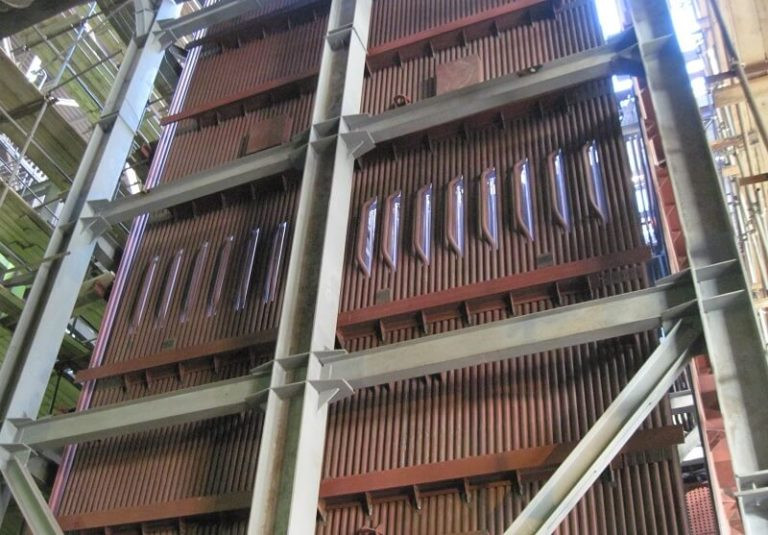
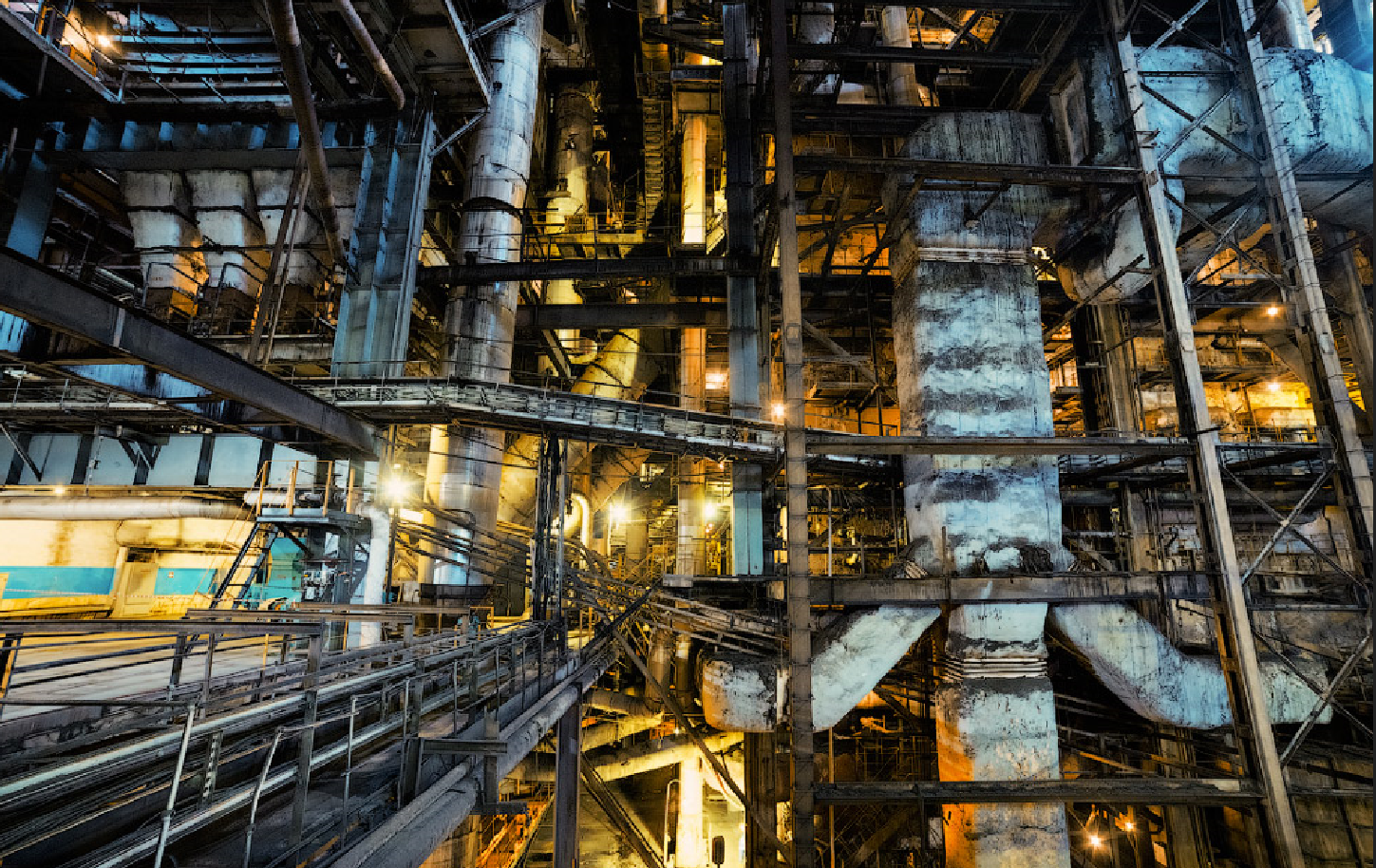
The most typical example of work performed in this direction is the reconstruction of two BKZ-320-140 boilers with an increase in their productivity from 320 t/h to 400 t/h at the thermal power plant of Aluminum of Kazakhstan JSC.
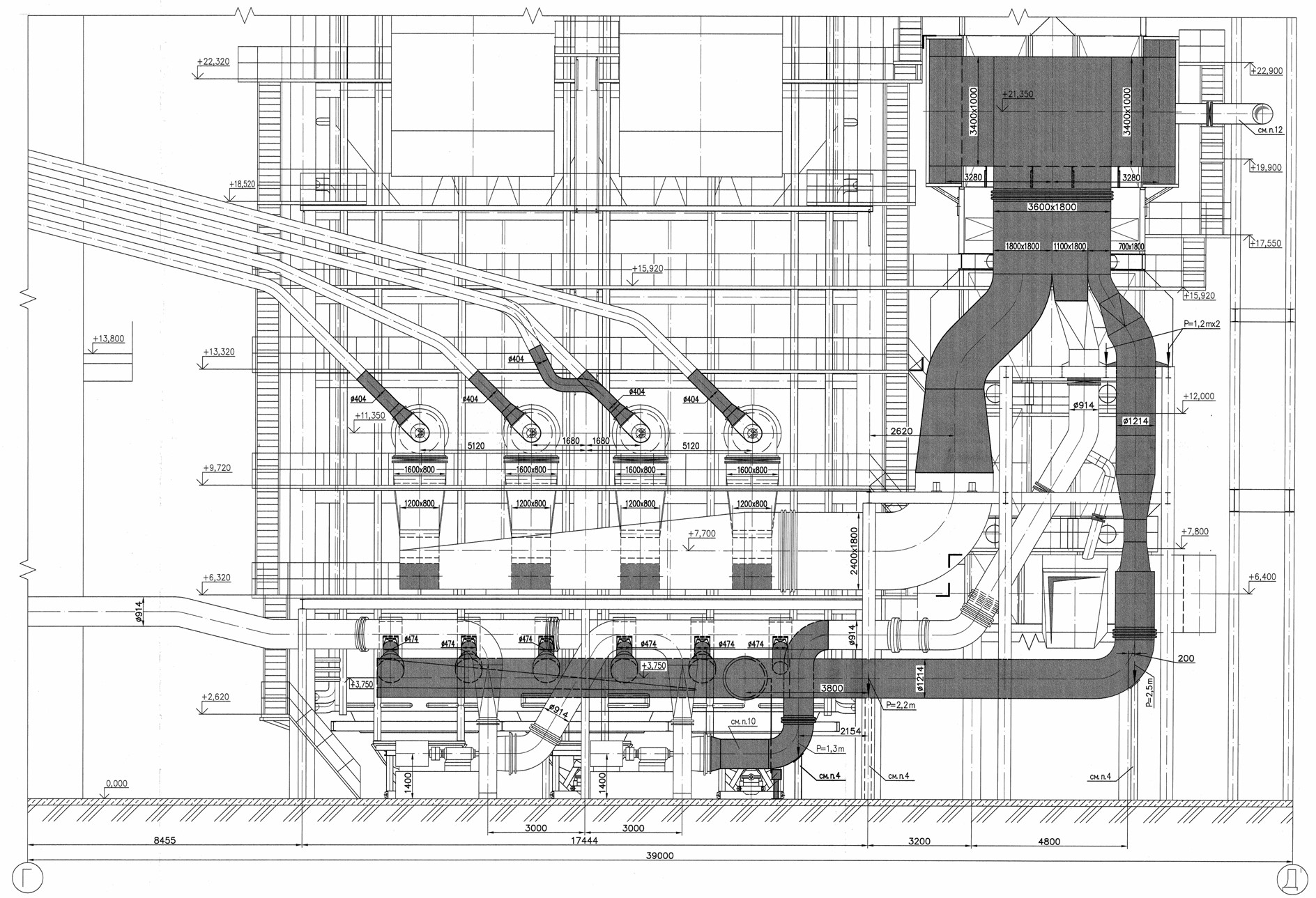
In the process of reconstruction of boiler units in combustion and burner devices, several technological methods of intra-furnace suppression of nitrogen oxides were simultaneously implemented:
- a bottom blowing system was installed;
- the dust supply system to the burners was transferred to PVKd transport;
- the vortex burners were replaced with direct-flow ones, in order to achieve slow mixing in the initial part of the torches, with their placement at the corners of the half-furnaces to organize the combustion of dust in two vortexes with centers in the middle of the half-furnaces;
- drying agent discharge nozzles are installed to form a tangential vortex feed above the main burners by 2.1 m.
Reconstruction results:
- after startup and commissioning, the boiler units confidently achieved a calculated steam load of 400 t/h. Boilers operate for a long time in the design mode in the absence of slagging of heating surfaces
- new combustion and burner devices - a two-vortex tangential arrangement of direct-flow burners with a bottom blast system made it possible to significantly reduce nitrogen oxide emissions from the boiler. The NOx concentration in the flue gases (reduced to an excess air of 1.4) when the boiler was operating at a design load of 400 t/h was 500 x 510 mg/m3, while before reconstruction, this parameter was when the boiler was operating at a load of 320 t/h was equal to 920÷930 mg/m3;
- reconstruction of wet ash treatment devices and installation of second-generation battery emulsifiers in them made it possible to increase the operational degree of flue gas purification from ash to an average of 99.40 x 99.47%, and reduce the mass concentration of ash at the outlet of the installation to 0.266 g/m3.
- reconstruction of morally and physically obsolete equipment with replacement of physically worn-out equipment;
- modernization of boilers in order to increase their productivity through the implementation of modern technological solutions and while maintaining the existing overall dimensions of the cells of the boiler itself and its auxiliary equipment;
- conversion of boilers and boiler houses to alternative fuels;
-improving the technical and economic performance of boilers and reducing unit costs through the introduction of more efficient technologies and materials;
- improving the environmental performance of boilers through the implementation of modern technological intra- and extra-furnace means for suppressing nitrogen oxides and equipping boiler units with highly efficient ash collectors with an ash collection coefficient of at least 99.4-99.5%, installed in existing cells and with maximum use of existing scrubbers;< br /> - processing of drawings from boiler equipment manufacturers to ensure their compliance with modern requirements of mandatory standards (heating surfaces, collectors and chambers, vessels, pipelines, etc.;
- the use of finned heating surfaces to increase heat removal or to reduce the weight of pipes used in convective packages by up to 40-50% while maintaining the same heat removal.
For all of the listed types of work, in addition to the development of technical solutions and working documentation, the following were also carried out:
- production and supply of non-standard equipment;
- supervision of the reconstruction and installation of equipment;
- commissioning works.
The most typical example of work performed in this direction is the reconstruction of two BKZ-320-140 boilers with an increase in their productivity from 320 t/h to 400 t/h at the thermal power plant of Aluminum of Kazakhstan JSC.
In the process of reconstruction of boiler units in combustion and burner devices, several technological methods of intra-furnace suppression of nitrogen oxides were simultaneously implemented:
- a bottom blowing system was installed;
- the dust supply system to the burners was transferred to PVKd transport;
- the vortex burners were replaced with direct-flow ones, in order to achieve slow mixing in the initial part of the torches, with their placement at the corners of the half-furnaces to organize the combustion of dust in two vortexes with centers in the middle of the half-furnaces;
- drying agent discharge nozzles are installed to form a tangential vortex feed above the main burners by 2.1 m.
Reconstruction results:
- after startup and commissioning, the boiler units confidently achieved a calculated steam load of 400 t/h. Boilers operate for a long time in the design mode in the absence of slagging of heating surfaces
- new combustion and burner devices - a two-vortex tangential arrangement of direct-flow burners with a bottom blast system made it possible to significantly reduce nitrogen oxide emissions from the boiler. The NOx concentration in the flue gases (reduced to an excess air of 1.4) when the boiler was operating at a design load of 400 t/h was 500 x 510 mg/m3, while before reconstruction, this parameter was when the boiler was operating at a load of 320 t/h was equal to 920÷930 mg/m3;
- reconstruction of wet ash treatment devices and installation of second-generation battery emulsifiers in them made it possible to increase the operational degree of flue gas purification from ash to an average of 99.40 x 99.47%, and reduce the mass concentration of ash at the outlet of the installation to 0.266 g/m3.